
By Jeremy Hovater:
For current owners and investors, valuation directly impacts capital strategy, refinancing leverage, growth decisions, and exit timing.
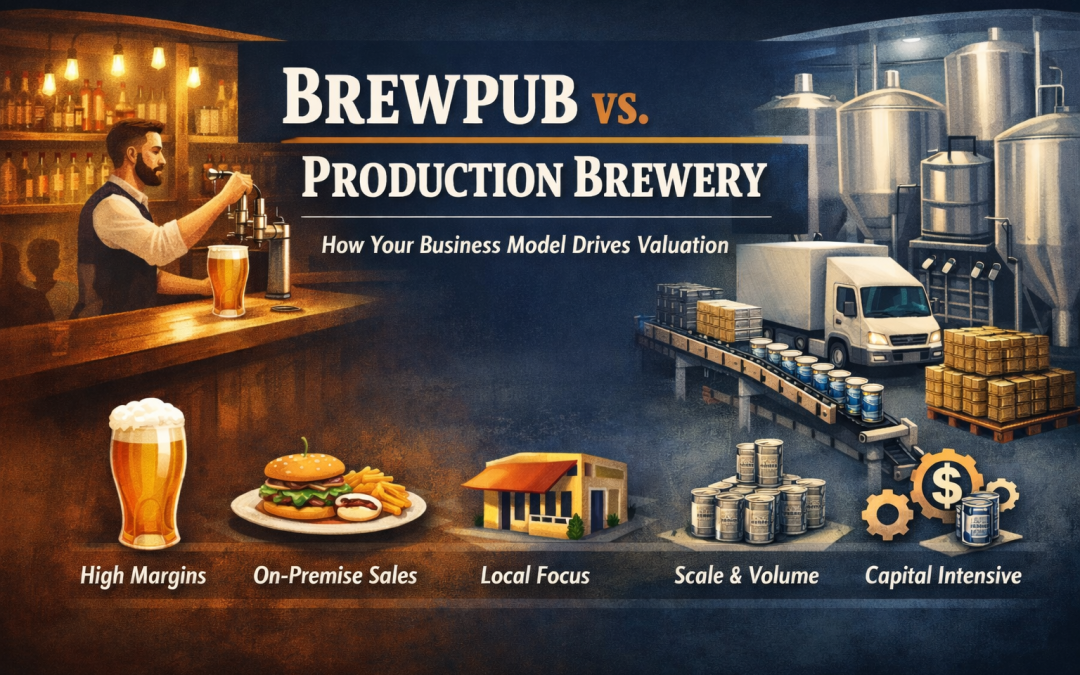
In today’s environment of margin pressure, distributor consolidation, and slower category growth, the distinction between a brewpub and a production brewery has become increasingly important. The market prices these models differently because the risk and scalability profiles are fundamentally different.
If You Own a Brewpub
Your valuation will typically be driven by cash flow durability at the location level.
Strengths
-
High direct-to-consumer draft margins (often 75%+)
-
Immediate cash cycle
-
Pricing control
-
Community-driven revenue base
Constraints
-
Labor intensity (kitchen + service staff)
-
Local traffic dependence
-
Limited scalability without opening new units
-
Hospitality-style operational volatility
From a buyer’s perspective, brewpubs are often underwritten like restaurant concepts. EBITDA multiples commonly range from ~2.5x–4.5x, depending on consistency, management depth, and lease structure.
If real estate is owned, value may shift significantly because the asset base becomes part of the return profile.
Owner takeaway:
Your valuation increases when earnings are stable, management is not founder-dependent, and lease or real estate risk is controlled.
If You Own a Production Brewery
Your valuation is driven less by taproom margins and more by brand strength, distribution durability, and growth trajectory.
Strengths
-
Scalable brand platform
-
Broader geographic reach
-
Strategic buyer universe
-
Ability to leverage fixed manufacturing overhead with volume growth
Constraints
-
Lower wholesale margins
-
Distributor dependence
-
Shelf-space competition
-
Higher working capital and capital expenditure requirements
Healthy, growing regional brands may trade in the ~3.0x–6.0x EBITDA range. However, flat or declining production breweries can fall below 3.0x due to risk concentration and capital intensity.
Strategic buyers place a premium on:
-
Diversified distribution
-
Consistent velocity
-
Gross margin discipline
-
Brand equity within defined markets
Owner takeaway:
Volume alone does not create value. Predictable growth and disciplined capital allocation do.
The Capital Efficiency Question
Investors are increasingly focused on return on invested capital (ROIC), not just top-line growth.
-
Production breweries typically carry larger equipment bases, packaging lines, and inventory.
-
Brewpubs carry heavy leasehold improvements and labor overhead.
The model that converts revenue to free cash flow most efficiently will command stronger interest — regardless of size.
Exit Optionality Matters
Brewpub exits are typically local or regional transactions unless a multi-unit platform exists.
Production breweries have a broader buyer pool:
-
Strategic craft consolidators
-
Regional beverage platforms
-
Private equity-backed rollups
That optionality can enhance valuation — but only if the business is positioned for scale.
What Owners and Investors Should Be Asking Now
-
Is our EBITDA normalized and defensible?
-
How dependent is performance on one individual?
-
Is our capital structure aligned with our growth model?
-
Are we investing for return — or just capacity?
-
If we went to market in 12–24 months, how would buyers classify us?
The market will categorize your business before it prices it. Whether you operate a hospitality-driven asset or a scalable manufacturing platform will shape both your multiple and your buyer universe.
At American Craft Brewery Advisors, we work with owners and investors to evaluate business model alignment, normalize earnings, assess capital efficiency, and prepare breweries for growth, recapitalization, or exit.
Understanding how your model impacts valuation is the first step toward maximizing it.