
By Jeremy Hovater
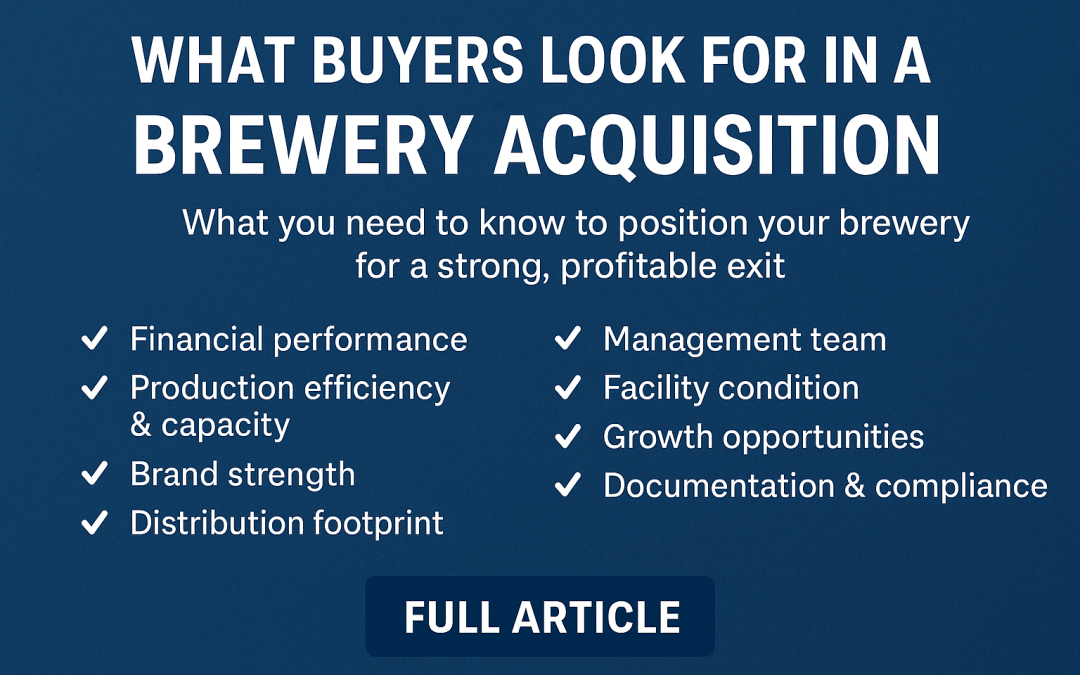
Whether you’re thinking about selling your craft brewery next year or five years from now, understanding what buyers care about most is one of the smartest steps you can take. In today’s craft beer market—marked by consolidation, rising production costs, and evolving consumer preferences—buyers are more selective than ever.
At American Craft Brewery Advisors, we work directly with private equity groups, strategic acquirers, and individual operators actively seeking brewery acquisition opportunities. Here’s what they consistently look for when evaluating a potential purchase.
1. Strong, Consistent Financial Performance
Buyers want to see predictable revenue and healthy margins. Key indicators include:
-
Stable or growing top-line revenue over the past 24–36 months
-
Healthy gross margins (often driven by production efficiency and ingredient management)
-
Positive EBITDA — or a clear path to profitability
-
Realistic, well-supported financial projections
If your brewery has seasonal fluctuations or one-time dips, transparency and documentation go a long way toward maintaining buyer confidence.
2. Production Capacity and Operational Efficiency
A brewery’s ability to scale production matters—whether the buyer is a strategic acquirer looking to grow quickly or an operator planning to optimize existing output.
Buyers evaluate:
-
Current production capacity
-
Equipment age, condition, and remaining useful life
-
Brewhouse layout and workflow
-
Cost per barrel and production efficiency metrics
-
Opportunities to expand capacity without major capital investment
A brewery running efficiently with room to grow is significantly more attractive.
3. Brand Strength and Market Position
In a crowded craft beer landscape, a strong brand can be more valuable than stainless steel.
Buyers want to see:
-
A loyal, repeat customer base
-
Strong brand identity and story
-
Unique or award-winning flagship beers
-
Social media engagement and positive press
-
Well-executed merchandising and packaging
If your brand resonates with its community, buyers pay attention.
4. Distribution Footprint and Sales Channels
A diversified and stable sales pipeline reduces risk for buyers.
Top factors they evaluate:
-
Wholesale distribution contracts and relationships
-
Self-distribution performance
-
Taproom revenue and foot traffic trends
-
On-premise vs. off-premise mix
-
Emerging markets or expansion opportunities
Taproom-centric models often attract higher valuations because of stronger margins and direct customer engagement.
5. Quality of Management and Staff
A brewery with a strong team is easier to integrate and maintain post-acquisition.
Buyers often look for:
-
A head brewer who consistently produces high-quality beer
-
A stable leadership team with clearly defined roles
-
Documented SOPs and repeatable processes
-
Low turnover
-
A positive workplace culture
If key personnel are willing to stay onboard post-transaction, value often increases.
6. Facility Condition and Compliance
A clean, organized, well-maintained facility communicates operational excellence.
Buyers check for:
-
Up-to-date licensing and regulatory compliance
-
Well-maintained equipment with service records
-
A clean brewhouse, cellar, and taproom
-
No outstanding liabilities, code issues, or environmental concerns
Compliance problems don’t just slow deals—they reduce valuations.
7. Growth Opportunities
Perhaps the biggest value driver in any acquisition: Where can the buyer take the business next?
Common growth levers buyers consider:
-
Adding distribution territories
-
Expanding canning or packaging capabilities
-
Adding food programs or taproom enhancements
-
Increasing off-premise retail penetration
-
Leveraging underutilized capacity
-
Launching new product lines (NA, sours, flavored, RTDs)
A brewery with documented, realistic upside consistently commands stronger offers.
8. Clean Books and Organized Documentation
Buyers want transparency. The more organized your records, the faster and smoother the acquisition.
Key documents include:
-
3–5 years of financial statements
-
Equipment list with estimated market values
-
Distribution agreements
-
Operating agreements
-
Lease contracts
-
Tax filings
-
SOPs and production records
Clean documentation reduces perceived risk—and boosts buyer confidence.
Preparing Your Brewery for Sale
If you’re considering selling within the next few years, the best first step is a professional valuation and readiness assessment. This helps you:
-
Understand your brewery’s market value
-
Identify strengths and weaknesses
-
Prioritize improvements that increase valuation
-
Plan the right timing and exit strategy
Thinking About Selling? We Can Help.
At American Craft Brewery Advisors, we specialize in mergers and acquisitions for the craft beer industry. Whether you’re exploring an exit, preparing for a sale, or simply want to know what your brewery is worth, we’re here to guide you.